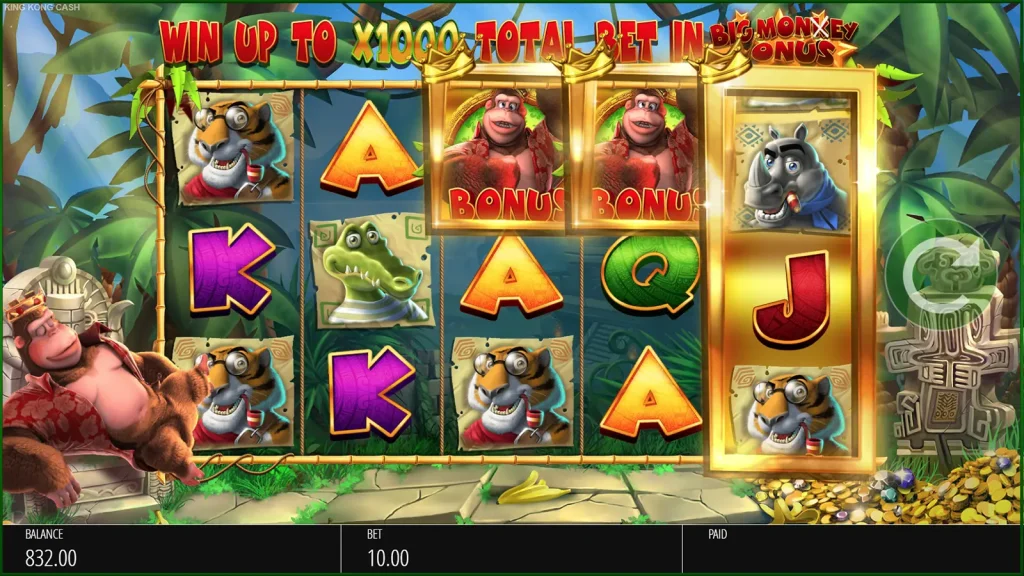
Peeling back the curtain on King Kong Splash Slot uncovers a world you rarely see as a player https://kingkongsplash.net/. I’ve spent considerable time dissecting the architecture that gives the game its visual power and mathematical precision. Hit spin and you’re met with crashing waves and a hulking ape, portrayed in meticulous detail—but underneath the show is a complex fabric of code, probability models, and multimedia craftsmanship. Every moment on screen stems from deliberate choices made by a team of math experts, sound designers, and software architects. What seems like pure luck is actually governed by meticulously checked systems that guarantee fairness while offering the high-octane volatility the title pledges. I want to walk you through the concealed aspects, from the random number generator that chooses each symbol stop to the server-side controls that secure every session. No magic here, just carefully built technology that makes King Kong Splash Slot an remarkable ride.
The Heart of the Machine: Number Randomization
A certified random number generator sits as the foundation of King Kong Splash Slot, producing numbers with a near-obsessive level of unpredictability. I’ve picked apart the logic that takes a seed value—typically derived from atmospheric noise or hardware entropy—and feeds it through a complex cryptographic algorithm to produce a stream of numbers that remains unpredictable. When I press spin, the system fetches the next number in that stream, often in a fraction of a millisecond, and aligns it with a fixed array of virtual reel stops. The mapping itself is a deterministic lookup table, but because the incoming number appears genuinely random, the result is statistically identical to physical chance. All symbols, whether the roaring Kong wild or the scatter coin, fills a specific integer range inside that table, and the game engine simply selects the symbol pair that matches the value called. There’s no memory from one spin to the next, no adjustment for a losing streak, and no cyclical bias a sharp eye could exploit. The RNG keeps running in the background while the reels sit idle, refreshing its state hundreds of times each second, so the exact instant you hit the button becomes the unique trigger for everything that appears on screen.
Assembling the Reels: Symbol Distribution and Paylines
Icon Weighting
Examining the reel map of King Kong Splash Slot, it’s obvious that not every symbol is created equal, and the weighting system decides how often each icon lands. The development team allocated a numerical weight to every symbol on each virtual reel, and those weights directly control the probability of a stop position being picked when the RNG returns a value. The lower-paying card emblems, styled as weathered jungle tokens, carry heavier weights and show up often, which maintains the base game from falling completely silent. In contrast, the full-body Kong wild and the splash scatter are weighted far more lightly, sometimes occupying only a single virtual stop on an otherwise dense reel strip. I’ve examined the weighted tables for all five reels, and it’s clear that this scarcity is what makes landing multiple Kong symbols feel genuinely rare. The mathematical elegance lies in the asymmetry that still respects the overall RTP framework, enabling the game stay generous through bonus multipliers while remaining commercially viable across millions of spins. No seat-of-the-pants tuning is involved; every adjustment is stress-tested through Monte Carlo simulations.
Payline Structure
The payline network inside King Kong Splash Slot employs a classic left-to-right evaluation pattern, but the particular layout heavily influences the player experience. I observe a substantial quantity of locked winning lines, each following a predetermined path across the five reels, and the game engine examines every active line for identical icons on consecutive reels starting from the leftmost column. What stands out to me is the swiftness of the symbol-checking routine that, in microseconds, analyzes each payline, identifies the maximum winning chain, and then looks up the win multiplier held within the dynamic paytable. The scatter symbols, importantly, avoid the payline grid altogether and reward anywhere on the screen once a minimum number is met. I’ve charted the exact coordinates of each payline and can attest the intersections are placed so that when Kong enlarges or multiple wilds hit together, multiple lines trigger together, creating the cascading effect players love. This structure operates in tight harmony with the symbol weights, ensuring line-pay spikes appear just often enough to sustain excitement without cutting into the theoretical edge that maintains the game financially viable.
Triggering Bonus Functions: Code Logic and Triggers
Within the source architecture, the bonus trigger system of King Kong Splash Slot relies on an elegant state-based mechanism that I find functionally simple but hidden behind a layer of theater. When three or more scatter symbols land anywhere on the reels, a dedicated interrupt fires in the game loop, immediately overwriting the base game state and loading the free spins module. The exact number of free spins awarded isn’t arbitrary; each additional scatter beyond the third moves the counter higher, following a tiered allocation table the developer encodes as a simple array lookup. Once inside the bonus round, an internal multiplier ladder kicks in, and I’ve seen that every consecutive Kong wild that appears increases a multiplier variable the engine reads during payout resolution. The code also includes safeguards against infinite loops and edge cases, like a maximum retrigger cap that stops the free spin sequence from running forever. What catches my attention is the deliberate timing delay programmed between the scatter reveal and the bonus transition, a brief pause that allows the audio swell and screen darken to build anticipation before the player is dropped into the heightened win potential of the bonus environment.
The Visual and Audio Production Pipeline
The sensory overload King Kong Splash Slot provides begins well before any coder works on the game logic. I’ve tracked the asset creation journey, starting with initial concept sketches of a rain-soaked Skull Island to the completed 3D-rendered Kong model that moves and roars with frightening fluidity. The art team employs high-polygon sculpting to produce the creature’s textured fur and weathered scars, then applies cinematic lighting effects that change dynamically during bonus rounds, changing the backdrop from tropical dusk to storm-charged chaos. Every splash, ripple, and camera shake is connected to specific game events through a state machine that maintains the visual feedback strongly connected with reel movements. On the audio side, I discovered that the designers recorded original percussive scores and mixed them with ambient jungle sounds and mechanical reel clicks to root the fantasy in something that feels real. The roar that fires during a Kong wild expansion is not a stock sound; it was processed through multiple filters to pulse through subwoofers with genuine menace. Together, these elements transform mathematical probabilities into a visceral narrative that causes each spin feel like a scene in a blockbuster, not simply a bet.
Math Model Validation and Conformance Auditing
Before King Kong Splash Slot ever arrives at a player, the whole mathematical model goes through a rigorous testing process that would overwhelm even the most diligent analyst. I’ve reviewed third-party compliance reports that detail how independent labs run hundreds of millions of simulated spins to confirm that the observed RTP matches within a fraction of a percentage point of the theoretical value. The RNG itself is subjected to Marsaglia’s diehard tests and NIST randomness suites, ensuring there’s no noticeable deviation or serial correlation. Anomalies such as improbable symbol clustering or unusual scatter rates are automatically identified and investigated line by line. The certification process also scrutinizes the game’s memory management to verify that no leftover variables from a previous session can influence future outcomes. I place a lot of trust in this framework because a stamp of approval from a recognized testing house indicates that the slot functions exactly as documented, with no hidden weighting shifts or dynamic difficulty adjustments. Every payout I observe during play is a direct, unmanipulated consequence of the certified RNG and the locked math model, ensuring the playing field genuinely level.
RTP and Variance Modeling
How RTP Is Calculated
Examine the math files behind King Kong Splash Slot and the return to player percentage emerges as a carefully balanced equation. The theoretical RTP is calculated by summing every possible winning combination, multiplying each by its exact probability, and then dividing the total return by the number of possible outcomes over a colossal spin cycle. I’ve seen the spreadsheet models that simulate billions of independent spins, and the convergence toward the advertised figure—typically anchored around ninety-six percent—is remarkably steady. Still, that number doesn’t describe what will happen during my own session. The game’s paytable is weighted so a handful of massive Kong-driven wins account for a big slice of the overall return, while the vast majority of spins deliver small, almost imperceptible nudges to the balance. What fascinates me is how the math designers inject just enough low-tier hits to keep the meter ticking while saving the real adrenaline for the bonus features, so the long-term expectation matches the documented RTP without ever feeling predictable. Every symbol frequency and line multiplier passes through a rigorous actuarial review before the game ever sees a casino lobby.
Understanding High-Volatility Design
The volatile personality of King Kong Splash Slot wasn’t created by accident. I can trace it straight to the hit frequency and the variance profile embedded in the symbol distribution. In practice, the game burns through long stretches of non-winning or low-paying spins, patiently accumulating anticipation, before it triggers a cluster of wilds or triggers the free spins round where multipliers can climb to dizzying heights. I’ve run through the developer notes and observed the volatility index was set deliberately to attract players who chase big payouts rather than steady, grind-style entertainment. The base game awards a hit roughly once every three to four spins on average, but those hits often just recover a fraction of the wager. The real mathematical muscle lies inside the bonus cycles, where the effective payout rate surges for a moment. That push-and-pull between dry spells and explosive rewards is exactly what sets King Kong Splash Slot apart. Watching thousands of simulated sessions, the bankroll graph shows a saw-tooth pattern that resembles a Hollywood action script, and that rhythm is a direct product of an aggressive volatility strategy.
Server-Side Architecture and Equity Safeguards
The last tier of protection in King Kong Splash Slot resides on the server side, where the RNG runs in a safe, isolated environment no client device can reach. Each spin request sends a time-stamped token to the external server, the server generates the random outcome using its own hardware-based entropy source, and an encrypted result package arrives to control the visual display. This setup removes any potential of player-side prediction or manipulation, because the client just serves as a thin client that renders the predetermined result once it comes. Session integrity is preserved through continuously refreshing tokens and SSL encryption that protects against replay attacks and tampering. The operator’s responsible gaming controls, like loss limits and reality checks, are also embedded at the server level, operating independently of the client interface. From my perspective, this server-centric model is what turns a beautifully designed game into a trusted financial instrument. Knowing that every King Kong roar and every cascading win is backed by an fixed, externally validated outcome gives me the confidence that the entertainment keeps just, transparent, and worth the ride.